


Share this
by Nynke Dijkstra on Feb 2, 2026, 3:09:43 PM
Packaging and processing machinery is getting more complex. Machines need to handle more formats, stricter regulations, higher output speeds, and seamless integration into complete production lines. At the same time, customers expect faster quotes, clearer proposals, and shorter lead times.
For many manufacturers, that creates a familiar tension: how do you scale sales and delivery without simplifying your machines or overwhelming engineering? The answer is not reducing customization. It is changing how configuration knowledge is captured, applied, and reused.
Can Packaging and Processing Manufacturers Handle Complete Project Configurations?
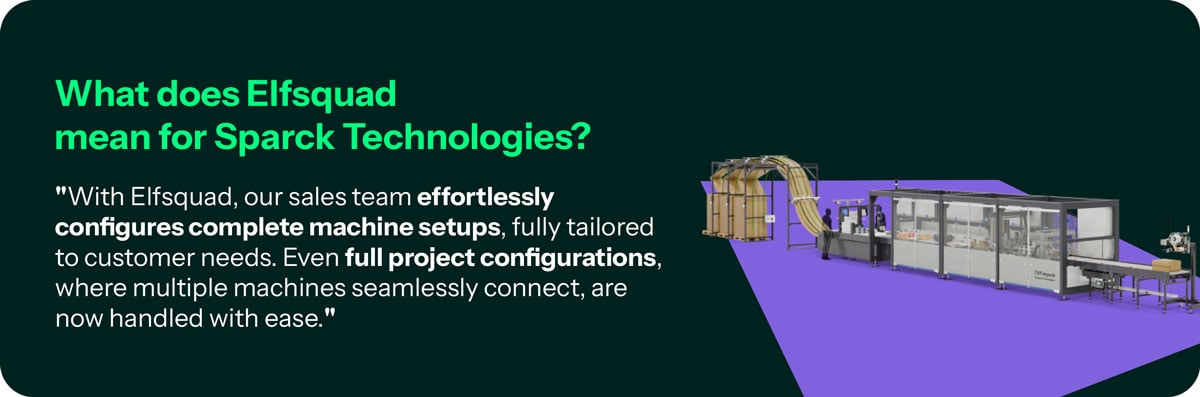
Yes, but only if the right tools are in place. For packaging and processing manufacturers, quoting rarely stops at a single machine. Customers buy complete production lines: multiple machines, conveyors, peripherals, and integrations that must work together as one system.
That is where most tools fall short. They handle individual products but struggle when configurations span entire projects. Elfsquad CPQ is built to model and configure full project configurations:
-
Multiple machines combined into one coherent line
-
Shared dependencies between modules and stations
-
Automatic validation across the entire system
-
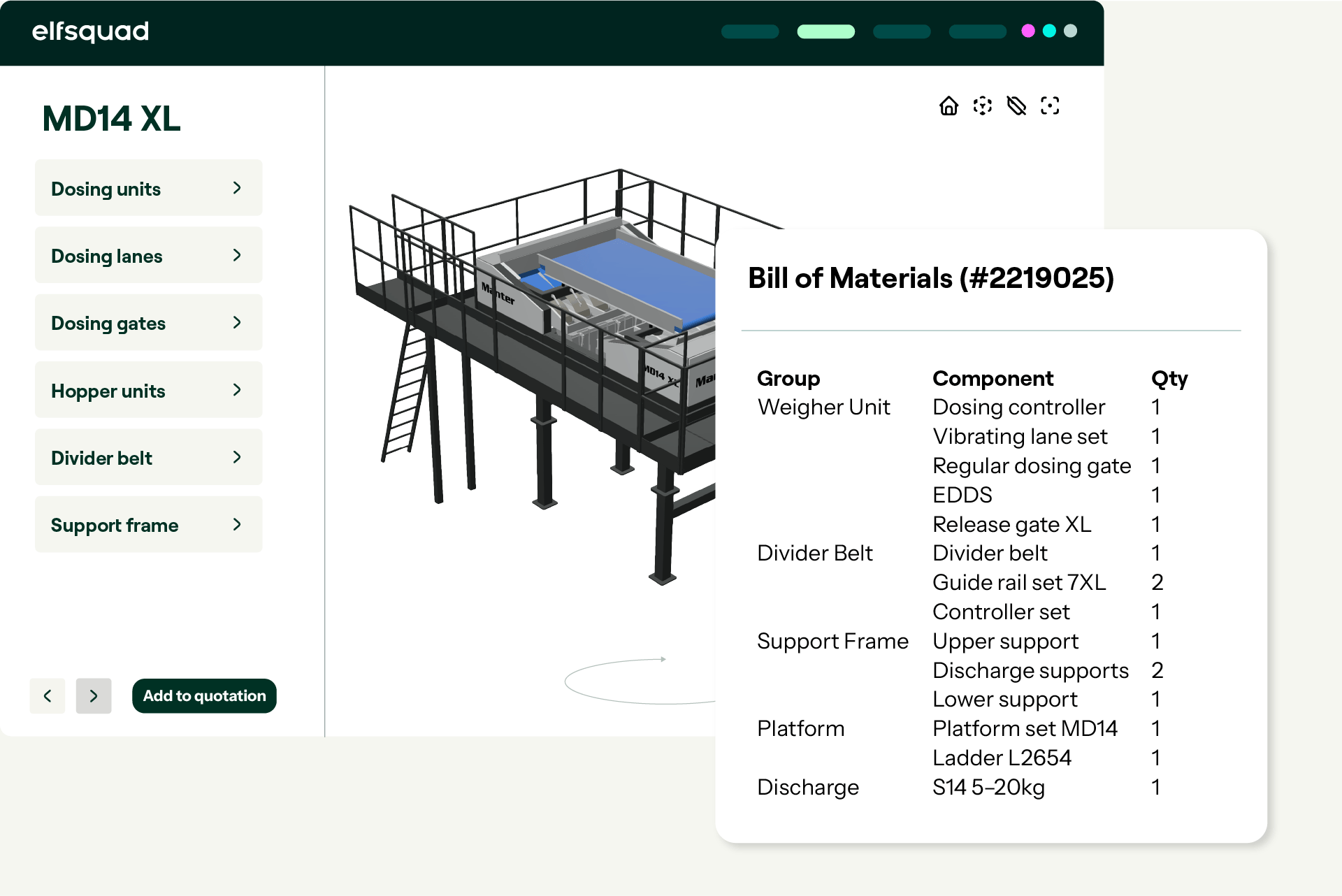
One consistent configuration as the basis for pricing, BOMs, and documentation
Sales teams can configure a full line in one flow, while engineering knows every combination is technically valid and production-ready.
Why Is Customization in Packaging Machinery So Complex to Manage?
No two packaging lines are identical. A single system may combine fillers, conveyors, sealing units, inspection systems, and palletizing equipment, all tailored to specific products, materials, speeds, and compliance requirements.
Even small changes, like switching packaging film or adjusting pouch size, can ripple through the entire configuration:
-
Module compatibility changes
-
Throughput calculations shift
-
Dimensions, pricing, and documentation all need updating
In many organizations, this logic lives in scattered documents, spreadsheets, and the heads of senior engineers. Sales teams rely heavily on engineering just to validate feasibility. That works until volume increases. Then it breaks.
Why Does Scaling Break Traditional Quoting Processes?
Scaling breaks traditional quoting because the process was never built for it. The same patterns appear across manufacturers who hit this wall:
-
Slow response times due to constant back-and-forth between sales and engineering
-
Higher error risk from outdated price lists and missed dependencies
-
Engineering bottlenecks that pull valuable experts away from innovation
-
Dealers who depend on HQ for every approval and check
In a market where buyers compare multiple vendors and expect fast answers, these delays directly impact win rates. Scaling sales with the same processes does not just slow growth, it actively limits it.
Does Scaling Require Simplifying Your Machines?
No. Manufacturers that scale successfully do not simplify their products. They standardize how decisions are made. By capturing configuration rules, compatibility, dimensions, pricing, and compliance requirements once, those rules can be applied consistently by sales and dealers without involving engineering every time.
Complexity shifts from people to systems. Flexibility stays intact. Your competitive advantage, the ability to deliver customer-specific solutions, remains yours. What changes is that it no longer depends on a handful of people to carry the knowledge. One source of truth, available to everyone who needs it.
How Does CPQ Software Support the Transition From ETO to CTO?
CPQ software makes the transition from engineer-to-order to configure-to-order manageable without removing the customization that makes your products valuable. Packaging and processing companies often start in an ETO model where every quote is checked manually and engineering validates nearly every detail. As product portfolios mature, that model becomes a constraint.
Moving toward configure-to-order does not remove customization, it removes repetition. Engineers define rules once. Sales and dealers apply them safely, every time. The result:
-
Less engineering involvement in routine quoting
-
Shorter sales cycles
-
More consistent quotes across regions
Engineering time shifts back to where it belongs: innovation and the complex exceptions that genuinely need expert attention.
How Do You Give Dealers More Independence Without Losing Control?
A dealer network scales without losing control when dealers have the tools to work independently within predefined boundaries. Global dealer networks are essential in packaging and processing, but they amplify inefficiencies when the right tools are missing.
Without structured product configuration support, dealers request approvals for every deviation, wait for manual checks, and rely on HQ for pricing clarity. That creates delays and inconsistency across markets. Modern CPQ enables dealers to configure and quote independently, with multi-language, multi-currency support and dealer-specific pricing built in. Empowered dealers sell more, faster, without increasing risk for the manufacturer.
Would you like to learn more about Elfsquad?
 or
or 